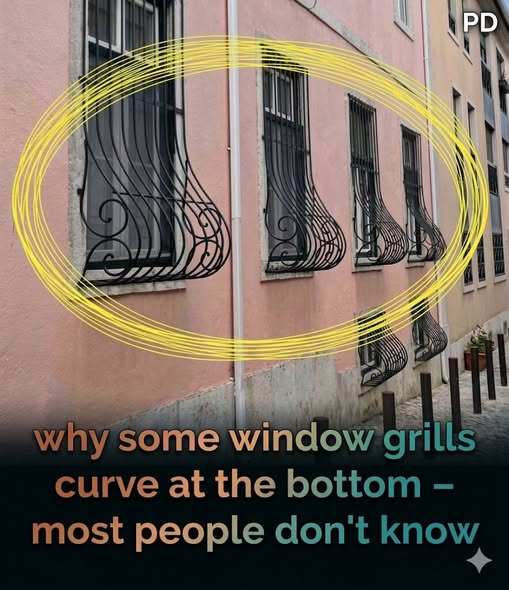
Why Do Some Window Bars Bulge Outward?
The surprising history and smart design behind those “potbellied” iron windows
If you’ve ever wandered through an older neighborhood — the kind with narrow streets, weathered shutters, and balconies dripping with plants — you may have noticed something curious about the windows.
Instead of sitting flat against the glass, some window bars curve outward.
Not just slightly, either. They puff out proudly, like a rounded belly, creating a cage-like shape that sticks out beyond the wall. At first glance, they can look odd. Maybe even decorative. Almost whimsical.
You might assume it’s just an architectural flourish. A stylistic choice. Something the builder added to give the façade character.
But those bulging window bars weren’t designed just to look interesting.
They’re one of those quietly brilliant everyday inventions — a perfect example of how practical problems shape design in ways we barely notice.
And once you understand why they exist, you’ll start spotting them everywhere.
Because those “potbellied” bars aren’t decoration at all.
They’re function disguised as charm.
Where it all began: security first
To understand the outward curve, you have to start with the original purpose of window bars.
Security.
Long before alarm systems, motion sensors, or smart cameras, protecting a home came down to simple physical barriers. Doors were reinforced. Locks were heavy. And windows — the most vulnerable entry point — were covered with iron.
Bars were straightforward and effective. They stopped break-ins while still allowing light and air to enter the house.
Especially in dense towns and cities, this mattered.
Many homes sat right on the street. Ground-floor windows were easy targets. Without bars, anyone could simply lift a latch or break a pane.
So people installed iron grilles.
Flat.
Tight.
Secure.
Problem solved.
… or so it seemed.
Because while flat bars protected homes, they also created a new issue.
They limited how people could actually use their windows.
The everyday problem nobody talks about
Imagine living in a small apartment decades ago.
No balcony.
No backyard.
No extra storage space.
Just a couple of rooms and a window looking out onto the street.
That window becomes more than just something you look through. It’s part of daily life.
You want fresh air.
You want sunlight.
You might want to grow a plant.
Maybe dry laundry.
Maybe cool off the room with a fan.
Maybe rest groceries or tools while cleaning.
But flat bars sit flush against the glass.
There’s no depth.
No usable space.
It’s basically a wall with holes.
And in crowded cities — where every square inch matters — that wasted space starts to feel frustrating.
So people did what humans have always done when faced with a small but persistent inconvenience.
They improvised.
The simple but genius solution
Someone, somewhere, had a practical thought:
“What if the bars didn’t sit flat?”
“What if they curved outward instead?”
That tiny change created something magical.
Space.
By bowing the bars outward, even just a few inches, they created a pocket of usable room between the window and the iron.
Suddenly, the window wasn’t just an opening.
It became a tiny extension of the home.
A mini balcony.
A micro shelf.
A protected ledge.
All without sacrificing security.
The bars still prevented entry.
But now they gave something back.
Airflow improved.
Light felt less blocked.
And, most importantly, the space became useful.
It’s one of those design upgrades that feels so obvious in hindsight you wonder how it wasn’t always that way.
Everyday uses you might not expect
Once the curved design spread, people started using that extra space creatively.
And this is where it gets charming.
Because it wasn’t just about function.
It became personal.
In many neighborhoods, those bulging bars turned into tiny showcases of daily life.
Plants and flowers
This might be the most common use.
Flower pots tucked safely inside the curve.
Herbs growing on kitchen windows.
Geraniums spilling color into the street.
In places without yards, this little iron pocket became a garden.
A private bit of green in a concrete world.
Storage
People stored surprisingly practical things:
cleaning tools
small boxes
shoes
firewood
grocery bags
fans or air coolers
It wasn’t glamorous.
But it worked.
And when you live small, “works” is everything.
Ventilation tricks
In hot climates, airflow matters more than aesthetics.
Curved bars allow windows to open wider without feeling blocked.
Some residents place fans or evaporative coolers in the space.
Others hang damp cloths to cool incoming air.
Tiny hacks that make a big difference.
Everyday resting place
Sometimes it’s as simple as:
setting down keys
placing a coffee cup
airing out laundry
That little ledge quietly becomes part of the home’s rhythm.
Why you see them most in certain parts of the world
If you start looking, you’ll notice these bars appear frequently in:
Southern Europe
Latin America
North Africa
the Middle East
older urban neighborhoods worldwide
That’s not random.
It comes down to three main factors.
1. Density
When homes are close together and outdoor space is limited, every inch counts.
Curved bars create “extra room” without expanding the building footprint.
2. Climate
Warm weather encourages open windows.
More airflow is valuable.
The curved shape helps air circulate freely.
3. Craftsmanship traditions
In many regions, ironwork is an art form.
Blacksmiths didn’t just make bars.
They shaped them beautifully.
So once outward curves proved useful, artisans started embellishing them.
Swirls.
Read more on the next page